

Beef Cuts in Israel: A Quick Street Hebrew Guide for the Butcher
If you’ve ever stood in an Israeli supermarket staring at frozen meat labeled with numbers, you are not alone. In Israel, many cuts of beef are numbered, based on the part of the cow they come from. You’ll see these numbers in supermarket freezers, and fresh meat is often sold the same way. A good Israeli butcher, or קַצָּב (katzav), will usually know the numbers by heart.
Here are the six of the most popular beef cuts you’re likely to meet.
Number 1: Entrecote
In Hebrew, this cut is often called אֶנְטְרֵקוֹט (entrecote), סְטֵייק עַיִן (steak ayin), or וֶרֶד הַצֵּלָע (vered hatzela).
This is a great cut for steaks, roast beef, grilling, and roasting. In the U.S., it is similar to rib, ribeye, or Delmonico steak. In the U.K., it is close to forerib.
Number 2: Chuck / Blade
In Hebrew, you may hear רִיפְעָן (rif’an) or צְלָעוֹת (tzla’ot).
This cut is better for slow cooking than quick grilling. It works well for pot roast, goulash, braising, and rich stews. In both the U.S. and U.K., it is usually known as chuck or blade.
Number 3: Brisket
In Hebrew, this is חָזֶה (chazeh) or sometimes בְּרוּסְט (brust).
This is the classic cut for salt beef in the U.K. or corned beef in the U.S. It is usually cheaper, fairly lean, and delicious when cooked slowly for several hours.
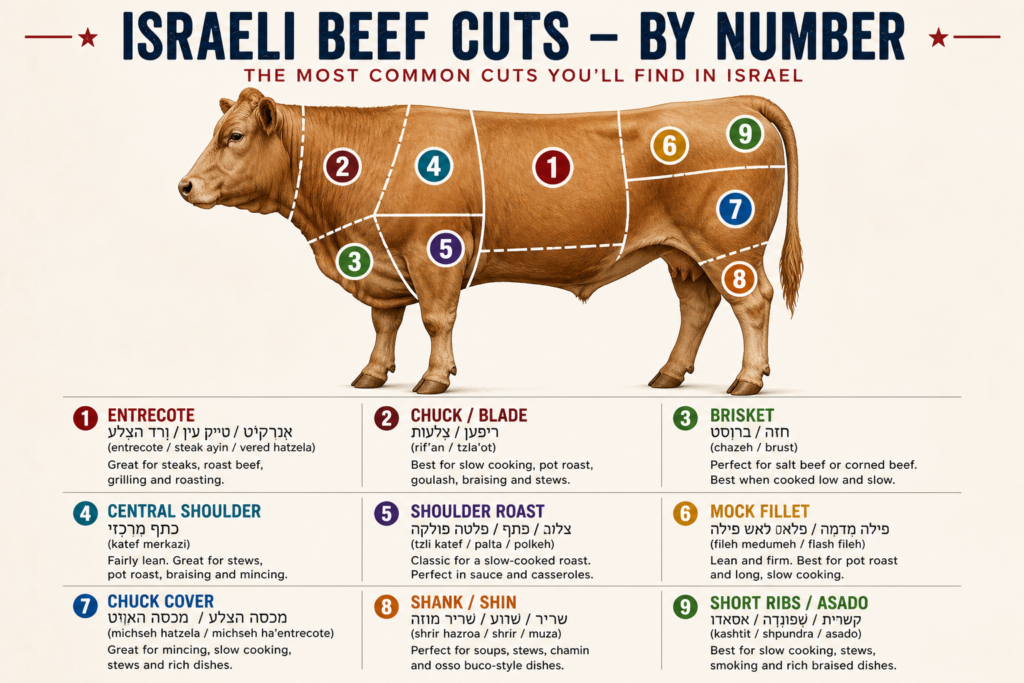
Number 4: Central Shoulder
In Hebrew, this is usually called כָּתֵף מֶרְכָּזִי (katef merkazi), meaning central shoulder.
This is a fairly lean cut with a consistent texture. It is best for slow cooking, stews, pot roast, braising, or mincing. It is not usually the cut you’d choose for quick grilling. Some guides compare it loosely to silverside or thick rib, though exact U.S./U.K. matches can vary.
Number 5: Shoulder Roast
In Hebrew, this is צְלִי כָּתֵף (tzli katef), also known in some butcher guides as פַּלְטָה (palta) or פּוֹלְקֶה (polkeh).
This is one of the classic Israeli cuts for a slow-cooked roast. It works beautifully in sauce, casseroles, and Shabbat-style pot dishes. It stays fairly juicy when cooked slowly and is often used for sliced roast beef.
Number 6: Mock Fillet
In Hebrew, this is פִילֶה מְדֻמֶּה (fileh medumeh), sometimes called פְלַאשׁ פִילֶה (flash fileh).
Despite the name, this is not true fillet. It is a leaner, firmer cut that needs slow cooking to soften properly. It is good for pot roast, cooking in sauce, and long braises, but not ideal as a quick steak.
Useful Butcher Vocabulary
Butcher: קַצָּב (katzav)
Traditional butcher shop: אִטְלִיז (itliz)
Lamb chops: צְלָעוֹת כֶּבֶשׂ (tzla’ot keves)
Chicken pieces: חֲתִיכוֹת עוֹף (chatichot off)
Fresh meat: בָּשָׂר טָרִי (basar tari)
Frozen meat: בָּשָׂר קָפוּא (basar kafui)
What is the price per kilo? מָה הַמְּחִיר לְקִילוֹ? (ma hamechir le-kilo?)
Book your free lesson
Street Hebrew helps Anglos and olim handle real-life Hebrew in Israel, from shops and schools to gas stations, appointments, and everyday conversations.